

- Jean Damascene
-
Jean Damascène
 Pour l’article homonyme, voir Saint Jean.
  Jean Damascène
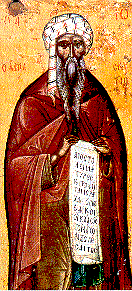 Jean Damascène
Jean Mansour ou Jean de Damas dit Jean Damascène, né vers 676 et mort le 5 décembre 749, théologien chrétien, père de l'Église et docteur de l'Église. Appelé en arabe Mansour ibn Sarjoun .
Issu d'une grande famille d'origine arabe de Damas, il sert le calife comme ministre. Puis, renonçant au monde, après sa controverse avec l'empereur byzantin Léon III qui était favorable aux iconoclastes et qui voulait le faire condamner par le calife, il devient moine à la laure de Saint-Sabas en Palestine.
Il fut l'auteur du De fide orthodoxa, important traité doctrinal. Il se lança dans une controverse acharnée avec l'islam, qu'il classa parmi les hérésies. Il compara les récits bibliques avec leurs versions reprises dans le Coran. Il est aussi l'un des principaux hymnographes byzantins et la liturgie lui doit les textes des matines pascales.
L'iconographie byzantine le représente avec un turban pour signifier ses origines arabes . Son père, Serge (Sarjoun), obtint des califes omeyyades qu'ils épargnent à Damas la basilique Saint Jean-Baptiste : elle fut transformée en mosquée 70 ans après la conquête musulmane. Les chrétiens obtinrent la construction de quatre églises par les musulmans en échange signe de tolérance islamo-chrétien en ère antique.
Il avait une vénération particulière pour la mémoire de deux grandes saintes martyres :
- Thècle d'Iconium, dont le tombeau est honoré à Maaloula, près de Damas et
- Barbara d'Héliopolis, honorée non loin de là à Baalbek.
Et il est mort le jour de la Sainte-Barbara, le 4 décembre 749. Il fut frappé d'anathème à titre posthume par le concile iconoclaste de Hiéreia. Il a été déclaré docteur de l'Église catholique romaine par le pape Léon XIII en 1890.
Voir aussi : Liste des saints de l'Église orthodoxe
Textes de Jean Damascène en Liens externes
- L'Exposé de la foi orthodoxe (De fide orthodoxa), suivi du 3e Discours pour la défense des icônes, en traduction française
- Le canon des matines de Pâques
Édition
CPG 8040-8127
Liens externes
- (fr) Saint Jean Damascène sur Nominis
- (en) Université de Balamand : St. John of Damascus, Life, Writings, Icons
- (fr) Vie de saint Jean Damascène, écrits, hymnologie
 Portail de la Syrie
 Portail des chrétiens d’Orient
Catégories : Docteur de l'Église | Père de l'Église | Saint catholique et orthodoxe | Théologien de l'icône | Théologien byzantin | Théologien orthodoxe | Littérature grecque byzantine | Religieux byzantin | Personnalité syrienne



Wikimedia Foundation. 2010.
